
Originally published: 06.MAR.2021
Article updated: 11.JUNE.2024
Medically reviewed by Dr. Sarah Conway
One of the most common questions I get asked during clinic visits is “Can STD symptoms appear the next day?” Unfortunately, it’s not the most straightforward of questions. In reality, each sexually transmitted disease can have a different set of symptoms, and varying incubation periods, and of course - everyone’s experience with certain infections can differ!
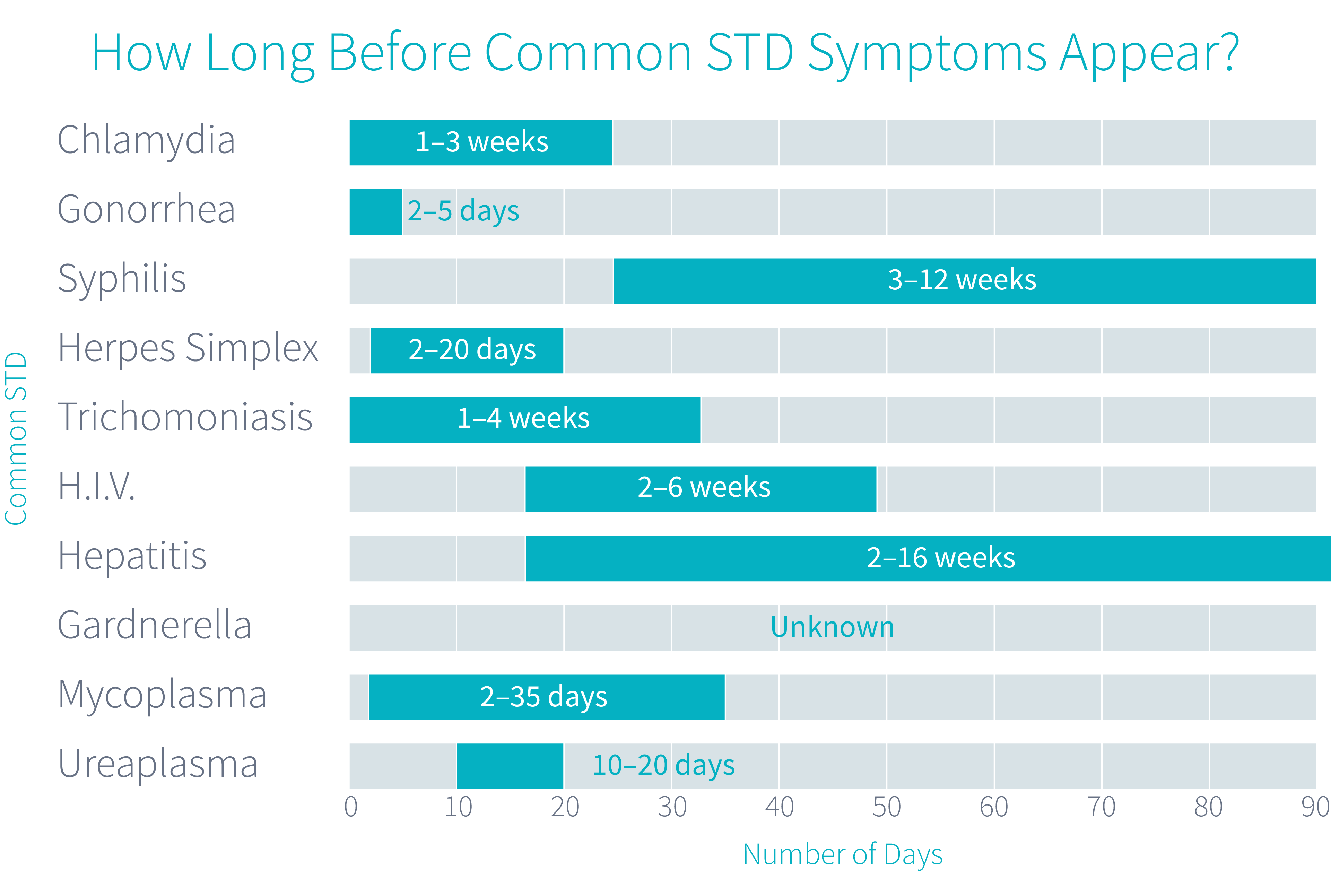
Below are just some of the suggested incubation periods for common STD symptoms to appear. Bear in mind, that every sexual health case is different, so these periods are subject to individual circumstances and may differ case by case.
If you are presently concerned about either your own or someone else's sexual health, an STD test can identify common sexually transmitted infections.

- Can STD symptoms appear the next day?
- What are the first signs of an STD?
- How soon do individual STD symptoms appear?
Can STD symptoms appear the next day?
It is possible for STD symptoms to appear the next day, but it largely depends on the sexually transmitted disease you have been exposed to, as well as the severity of symptoms your sexual partner is experiencing. However, the likelihood of waking up the day after the night before with very noticeable or extreme STD symptoms is low.
There are a number of sexually transmitted diseases that may have early signs and symptoms. These include two of the more common infections, Herpes & Gonorrhea.
Herpes
The symptoms of herpes may appear within 24-48 hours following contact, but it can also take months or even years for symptoms to appear and it is possible to carry the virus with no symptoms at all. Have you ever kissed someone with a cold sore and woke up the next day with an annoying blister on your lip? This is usually the HSV-I strain of herpes.
Both HSV 1 & 2 strains may cause genital herpes.
The symptoms of the viral strain that causes genital herpes may also appear the day after sexual intercourse. This HSV-2 strain of herpes causes genital herpes. If you notice blisters, ulcers, and/or unusual lumps or bumps the day after unprotected sex, it is one of the tell-tale signs of herpes.
Some of the other most common symptoms of genital herpes include small blisters on the genitals or rectal area, itching or a burning sensation on the genitals or rectal area, and cracked, raw, and/or red skin on the genitals or rectal areas.
Related article: Can Herpes Go Away On Its Own?
Gonorrhea
The symptoms of gonorrhea may also appear within 24-48 hours following contact. The most common sign of gonorrhea is a thick, cloudy, or bloody discharge from the penis or the vagina.
For that reason, gonorrhea is often referred to as the “drip”, it is also commonly known as “the clap”.
The symptoms of other common sexually transmitted diseases will generally take a little longer to become apparent. These include chlamydia, syphilis, mycoplasma, Gardnerella, trichomoniasis, hepatitis B&C, H.P.V., and H.I.V.
Taking a test is the most effective way of discovering whether you have a sexually transmitted infection or not.
Related article: Chlamydia and Gonorrhea: How to Know The Difference
What are the first signs of an STD?
The most common first signs of an STD include:
- Abnormal bleeding
- Pain during sex
- Pain in the pelvic area
- Pain in the testes
- Unusual bumps and/or blisters
- A change in the color or smell of vaginal discharge
The first signs of an STD depend on the type of STD you have contracted. Some sexually transmitted diseases may show signs and symptoms the very next day, while others can remain dormant for years.
STDs that may show signs and symptoms soon after exposure include herpes and gonorrhea.
Chlamydia, which is the most commonly reported sexually transmitted disease, typically has an incubation period between 1-3 weeks; however, chlamydia can remain dormant for years.
Human papillomavirus (HPV). is another good example of a sexually transmitted disease that can either present with symptoms early, including warts, or it can remain dormant for years in cases where the body has not been successful in fending off the virus.
Put simply, the first signs of sexually transmitted disease really depend on the type of sexually transmitted disease you have contracted, however, it is important to remember that most sexually transmitted diseases do not have any symptoms.
Related article: What Happens When You Leave an STD Unchecked?
How Soon Do Individual STD Symptoms Appear?
It’s important to be aware of the signs and symptoms of sexually transmitted diseases. Equally, it’s important to be aware of how long it may take for said sexually transmitted diseases to become active and the time periods that you should be getting tested.
Chlamydia
The symptoms of chlamydia may become apparent 1-3 weeks after exposure, though the obvious symptoms of chlamydia may remain dormant for months if not years.
Gonorrhea
The symptoms of gonorrhea can become apparent 24-48 hours following exposure in some cases. However, in most cases, it will take 2-5 days. In other cases, it may take up to 30 days for symptoms to become apparent.
Syphilis
The symptoms of syphilis generally take up to three weeks to develop. In some cases, it can take up to 3 months (90 days) to notice symptoms. The side effects of untreated syphilis over a substantial period of time can take years to present themselves.
Herpes Simplex I (HSV-I)
The symptoms of herpes can become apparent the day after exposure, however, in most cases, these symptoms will not become apparent until 2-20 days following infection.
Trichomoniasis
The symptoms of trichomoniasis generally take 1-4 weeks to become apparent following exposure.
H.I.V.
The symptoms of H.I.V. generally take 2-6 weeks to become apparent following initial infection. In some cases, the infection can take years to develop, which is why screening is so important, especially if you are in the high-risk group.
Hepatitis
The symptoms of hepatitis generally take 2 weeks to 4 months to become apparent depending on the type of hepatitis and the means through which you contracted the virus.
Gardnerella
Gardnerella (a.k.a bacterial vaginosis or B.V.) is a bacterial infection in which the flora of the vagina becomes imbalanced due to lactobacillus bacteria. Men can also rarely be infected with Gardnerella, though it is usually asymptomatic. As it is not fully understood how sufferers are infected with the bacteria, it is not fully understood how long it will take for the symptoms of Gardnerella to develop.
Mycoplasma
The symptoms of mycoplasma generally take 2-35 days to become apparent following the initial infection.
Ureaplasma
The symptoms of ureaplasma generally take 10-20 days to become apparent following the initial infection.
Related article: Can STDs Go Undetected?
The most accurate way to know if you have contracted an STD is to test - you can do this with your local doctor or with LetsGetChecked’s range of sexual health testing options.
You should consider testing if:
- You become sexually active
- You have had unprotected sex
- You are experiencing symptoms of a sexually transmitted infection
- You are entering into a new sexual relationship
- You have received a notification from a previous partner that they are infected (STIs can remain dormant for years and/ or take up to three weeks to become detectable.)
Please note that the following is for educational use only and is not a substitute for medical advice. This content cannot diagnose or provide information about treatment. Consult with your healthcare provider if you have any concerns or need specific medical advice relating to any symptoms, conditions, diagnosis, or treatment. Do not delay seeking medical advice and do not disregard professional medical advice based on this content. Your healthcare provider can provide the most suitable guidance based on your situation.


